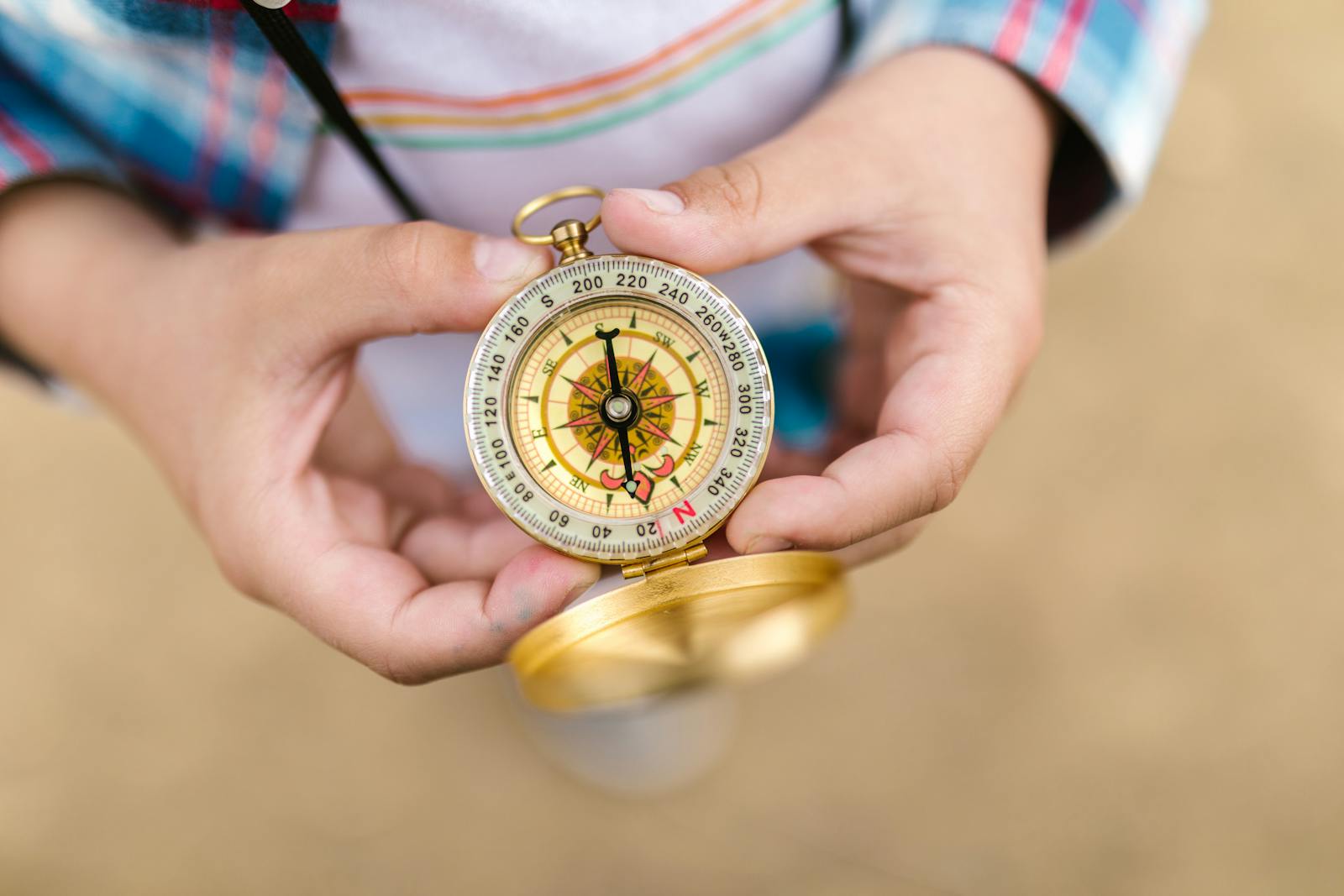
Imagine standing on the edge of an uncharted path, your heart pounding with excitement as the wilderness beckons you to explore its hidden treasures. For many, the idea of relying solely on a map and compass feels like an ancient art or perhaps an intimidating venture. Yet, the thrill of navigation through unspoiled landscapes is an experience that liberates and empowers.
Whether you're planning a weekend hiking trip or merely seeking to disconnect from the digital world, mastering the basics of map & compass navigation for beginners can open doors to breathtaking adventures.
Forget the frustration of modern-day GPS failures or the unreliability of smartphone batteries draining at inopportune moments. Instead, imagine the satisfaction of charting your own course, confidently finding your way even when technology fails. With the proper guidance, anyone can learn to navigate the natural world with ease.
In this post, we'll demystify the process for newcomers, providing straightforward insights that will transform the wilderness from a daunting uncertainty into a thrilling playground of exploration. Get ready to embrace the great outdoors like never before!
Understanding the Basics of Map and Compass Navigation
At its core, map & compass navigation for beginners is about understanding two fundamental tools: the map, which offers a scaled, two-dimensional representation of terrain, and the compass, which provides reliable directional bearings.
A topographic map uses contour lines to depict elevation changes and symbols to indicate natural and man-made features—valleys, ridges, rivers, trails, and landmarks. A compass consists of a magnetic needle, orienting lines, a rotating bezel, and often a transparent baseplate marked with scales and rulers.
When used together, these tools enable hikers to translate a flat map into real-world directions, aligning map features with actual surroundings. Learning to maneuver both map and compass requires familiarity with basic map reading (such as identifying north, interpreting legends, and understanding scales) and compass handling (including holding it flat, reading bearings, and adjusting for magnetic declination).
Magnetic declination—the angle difference between true north and magnetic north—varies by location and must be accounted for to ensure accuracy. Once you grasp these essentials, you’ll be equipped to plot courses, estimate distances, and make confident navigational decisions even in unfamiliar or challenging environments.
Choosing the Right Compass for Beginners
Selecting an appropriate compass can dramatically impact your first foray into traditional navigation. Beginners should look for a baseplate compass, which combines a clear, rectangular acrylic plate for map overlay with a rotating bezel marked in degrees.
Look for a model with an adjustable declination scale so you can set local variation once and avoid mental math on the trail. A sighting mirror or notch can help with more precise bearings if you plan to navigate complex terrain, while a lanyard or wrist strap ensures you won’t misplace your compass during active hikes.
Durability is another key factor. Choose a compass with liquid damping (which stabilizes the needle more quickly) and a sturdy housing that can withstand bumps and drops. A good beginner’s compass will be lightweight, easy to read in low light conditions, and feature scales for measuring distances on different map types.
Many brands also include rulers, protractors, and even map magnifiers on the baseplate—features that simplify tasks like pacing and plotting waypoints, making them ideal for novices honing their orienteering skills.
Reading Topographic Maps for Navigation
Topographic maps are the backbone of reliable navigation, offering detailed depictions of landscape features through contour lines and standardized symbols. Contour lines connect points of equal elevation, tracing ridges, basins, peaks, and saddles; the closer the lines, the steeper the terrain.
Map legends decode symbols for trails, water sources, vegetation density, and man-made structures like campsites, roads, and shelters. A clear understanding of scale—often 1:24,000 on USGS maps—lets you convert map distance to real-world miles or kilometers.
Reading these maps effectively involves three steps: first, orient the map so that north on the map aligns with true or magnetic north in the environment; second, identify your current position using recognizable landmarks or a process called resection; and third, plan a route that considers both horizontal distance and vertical gain.
By studying contour intervals and features, you can choose the most efficient path, avoid unexpected cliffs or swampy areas, and estimate travel times accurately.
Practice interpreting contour shapes—such as V-patterns pointing upstream or concentric circles indicating summits—to build spatial awareness before heading into the field.
Orienting Your Map with a Compass
Orienting your map means aligning it with the real world so that north on the map corresponds to magnetic north in your surroundings. To start, lay the map flat on a smooth surface and place your compass on top, ensuring the baseplate’s edge runs parallel to the map’s north-south grid lines.
Rotate the bezel so that the orienting arrow points to north on the map, then turn both map and compass together until the magnetic needle aligns within the bezel’s red orienting arrow. Now, features on your map should match what you see around you, simplifying the task of locating landmarks and planning routes.
Mastering map orientation enhances your ability to relate map symbols to visible terrain features. Whether you’re trying to spot a nearby ridge or confirm a stream crossing, having a correctly oriented map reduces guesswork. When hills, rivers, and trails align with the map’s layout, you’ll gain confidence in navigation and make more informed decisions.
Periodically re-orient your map as you travel to account for course deviations and maintain situational awareness, especially in dense forests or low-visibility conditions.
Using Compass Bearings to Navigate
Compass bearings translate your intended direction on the map into a physical heading you can follow in the field. To take a bearing from your map, mark your current position and desired destination, then place the compass edge between these two points.
Rotate the bezel until the orienting lines run parallel to the map’s north-south grid, ensuring the orienting arrow points north. Read the bearing degree at the index line and remember this magnetic heading.
In the field, hold your compass flat at waist height and rotate your body until the magnetic needle aligns with the orienting arrow. The direction-of-travel arrow now points toward your destination. Begin walking, periodically checking that the needle remains within the orienting arrow to maintain accuracy.
For longer routes, break the journey into bite-sized legs, taking fresh bearings at identifiable features. Learning to switch between forward bearings and back bearings (adding or subtracting 180°) helps verify return routes or correct compass fluctuations caused by terrain and metal objects.
Navigating Terrain Features with a Map and Compass
Understanding how to use terrain features—such as valleys, ridgelines, streams, and saddles—enhances both efficiency and safety during outdoor expeditions. By identifying distinct landforms on your map and in the environment, you can follow natural guides instead of relying solely on compass bearings.
A ridgeline may offer a clear path with reduced vegetation and increased visibility, while valley bottoms often provide water sources and gentler grades. Mapping these features ahead of time simplifies route-finding and reduces fatigue.
When plotting your journey, note key landmarks that correspond to unique map symbols: a distinct bend in a stream, a rock outcrop, or a junction of trails. As you travel, continuously verify your location by matching visible features with the map.
If you’re cresting a hill, pause at the top to locate multiple map points—like a nearby peak or a distant watercourse—and triangulate your position. These real-world checks reinforce confidence and minimize navigational errors, enabling you to adjust course proactively should conditions change or unexpected obstacles arise.
Practical Tips for Successful Map and Compass Navigation
Preparation and practice are the cornerstones of reliable navigation. Before hitting the trail, study your route on a map, identifying potential hazards, water sources, and contingency paths. Print or carry a waterproof copy of your topographic map, and record key waypoints and bearings in a small notebook.
On the trail, maintain a steady pace count—typically 20 to 25 steps per 100 meters—to estimate distance traveled. Combine pace counting with timing; for example, if you cover 1 kilometer in 15 minutes on flat ground, adjust for uphill or rough terrain based on pre-trip planning.
During your outing, keep your map oriented and periodically confirm your position with visible landmarks or compass resection. Use simple mnemonics—such as “red in the shed” for keeping the red needle in the orienting arrow—to reinforce technique under stress.
In low-light or foggy conditions, rely on prominent features like trail junctions or water crossings, and slow your pace to minimize errors. Finally, practice in familiar areas before tackling remote wilderness, ensuring you know how to handle unexpected challenges without depending on electronic devices.
Building Confidence in Map and Compass Skills
Confidence grows with deliberate, incremental practice. Start by navigating familiar local trails, focusing on one skill at a time—reading contour lines, taking bearings, or pacing distances. As you master each component, combine them on longer loop hikes, gradually introducing more complex terrain.
Participating in orienteering events or GPS-free scavenger hunts can provide structured challenges and immediate feedback, reinforcing proper techniques under friendly competition.
Learning from mistakes is essential. When you veer off course, pause, reassess using your compass and map, and correct without hesitation. Keep a field journal of route successes and errors to analyze later. Partnering with more experienced navigators offers mentorship, while teaching friends what you’ve learned deepens your own understanding.
Over time, small victories—like pinpointing your location by triangulation or confidently crossing featureless terrain—will accumulate, transforming initial uncertainty into assured exploration.
Troubleshooting Common Navigation Challenges
Even seasoned navigators face setbacks. Magnetic interference from electronic devices, large metal objects, or certain rock formations can skew compass readings; if bearings fluctuate, find an open area away from metal, hold the compass away from your body, and recalibrate.
In low-visibility conditions—fog, dense forest, or twilight—slow your pace, maintain contact with known features, and confirm each leg by counting paces and time. If you become disoriented, stop, take a few deep breaths, and use identifiable landmarks to reorient your map.
Map misinterpretation is another frequent issue. Contour lines can appear similar in rolling hills or gentle slopes; when in doubt, triangulate using two or three distinct, easily spotted features.
Carry spare map copies in waterproof cases, and ensure your compass housing is clear of bubbles that hinder needle movement. By anticipating these hurdles and applying simple corrective steps—like resection, back bearings, or terrain association—you’ll overcome navigational challenges and stay on course, no matter how unpredictable the environment.
Embracing the Adventure
Mastering map and compass navigation transforms hiking from a GPS-dependent routine into an empowering journey of self-reliance and discovery. By learning to read topographic maps, choose the right compass, and plot accurate bearings, beginners can confidently explore terrain of all kinds.
With practice, patience, and the willingness to troubleshoot challenges, you’ll unlock a world where every ridge crest and river crossing becomes part of the adventure. Embrace the art of traditional navigation and let the wilderness guide you toward unforgettable experiences.




0 Comments